
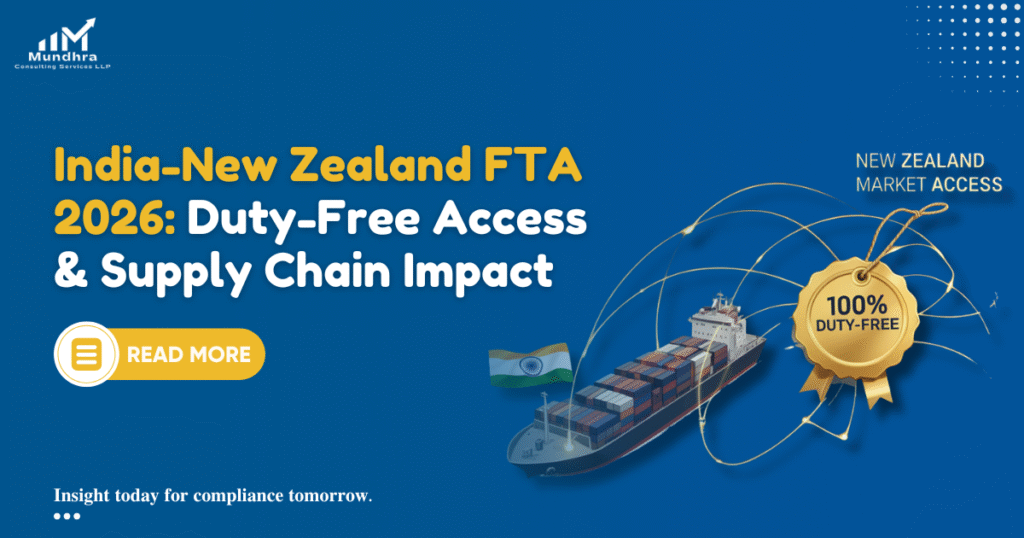
On April 27, 2026, India and New Zealand officially signed a historic Free Trade Agreement (FTA), marking a generational shift in bilateral economic cooperation.
For Indian manufacturers, exporters, and supply chain directors, this is not just a diplomatic milestone – it is an immediate catalyst for cost optimization. The agreement unlocks a balanced tariff concession framework, grants unprecedented market access, and secures a $20 billion bilateral investment pipeline over the next 15 years.
However, modern FTAs are complex instruments. Beneath the headline numbers lie highly specific mechanisms designed to balance global integration with domestic protection. Here is a technical breakdown of the India-New Zealand FTA and what it means for your global trade operations.
Overview of India-New Zealand FTA
1. The Export Advantage: 100% Tariff Elimination
The most immediate and aggressive benefit of this FTA falls to Indian exporters.
New Zealand has agreed to grant immediate, 100% duty-free access across all 8,284 of its tariff lines. This eliminates the border costs that have previously hindered Indian goods in the Oceania market.
Sectors Poised for Immediate Growth: This zero-tariff framework significantly strengthens India’s competitiveness against other Asian manufacturing hubs, particularly in labor-intensive and highly manufactured sectors, including:
- Textiles, Apparel, and Garments
- Leather and Footwear
- Engineering Goods and Machinery
- Pharmaceuticals and Auto Components
- Plastics and Processed Foods
2. The Import Strategy: Calibrated Tariffs & TRQs
While securing open access for its exports, India has deployed a highly strategic, “calibrated approach” to its own import tariffs to shield domestic industries from sudden foreign competition.
- Phased Reductions: India will offer immediate duty elimination on only 30% of tariff lines, with phased reductions applied to 35.6% of lines spread over 3 to 10 years.
- Protection of Sensitive Sectors: Crucially, India has fully excluded sensitive sectors from any tariff concessions. Local industries spanning dairy, edible oils, sugar, spices, and onions remain heavily protected.
- Deployment of TRQs: For specific agricultural imports where New Zealand is a global powerhouse (such as apples and kiwi fruit), India has utilized Tariff-Rate Quotas (TRQs) coupled with Minimum Import Prices (MIP). This ensures domestic farmers are not undercut by a flood of cheap, duty-free agricultural imports.
3. Services, Mobility, and the $20B Investment Pipeline
Beyond the movement of physical goods, the FTA lays the groundwork for massive capital and talent integration.
- $20 Billion Investment: The agreement facilitates a target of $20 billion in foreign direct investment (FDI) into India over the next 15 years, targeting infrastructure, technology, and manufacturing scale-ups.
- AYUSH and Wellness: In a landmark victory for India’s soft power and services sector, the FTA explicitly recognizes AYUSH (Ayurveda, Yoga, Unani, Siddha, and Homeopathy) and related wellness services, creating official pathways for Indian practitioners to operate in New Zealand.
- Professional Mobility: The pact includes expanded visa provisions, securing 5,000 visas annually for Indian professionals and expanding post-study work opportunities.
Strategic Business Implications: What You Should Do Next
An FTA is only as valuable as the corporate initiative taken to leverage it. For Indian businesses, this agreement should trigger an immediate review of international operations.
- Recalibrate Landed Costs: If you export to New Zealand (or plan to), your pricing models must be updated immediately to reflect the 100% tariff elimination, potentially allowing you to capture higher margins or aggressively undercut competitors.
- Supply Chain Restructuring: Firms should examine their manufacturing footprints. With a stable, duty-free corridor established, businesses can confidently build long-term, resilient bilateral supply chains.
- Assess Import Viability: For businesses relying on New Zealand imports, analyze the 30% immediate elimination list to see if your raw material procurement costs can be optimized under the new framework.
Optimize Your Global Trade Strategy with Mundhra Consulting Services
Consult MCS ExpertsAlso Read: CBIC Clarifies Section 74 Duty Drawback for SEZ to DTA Clearances
