
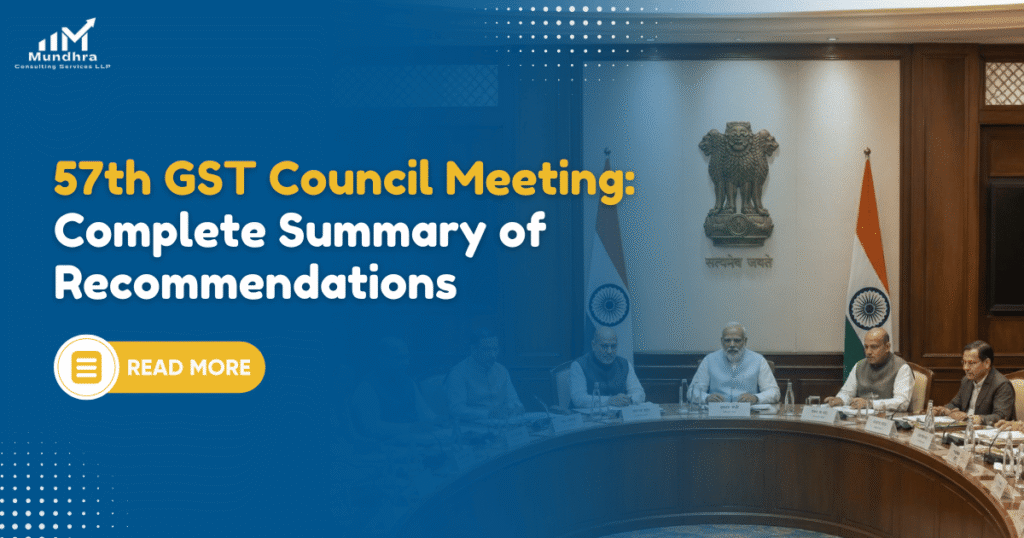
The 57th meeting of the GST Council, held on October 8, 2026 at Bharat Mandapam, New Delhi under the chairpersonship of Union Finance Minister Smt. Nirmala Sitharaman, has delivered what is arguably the most reform-heavy set of recommendations since the inception of GST. Originally scheduled for September 12, 2026, the meeting was postponed and rescheduled to October 7 before finally being held on October 8.
The recommendations span decriminalization of GST offences, a fundamental overhaul of the Input Tax Credit framework, automation of the refund process, rationalization of penalties, significant GST rate changes on goods and services, restrictions on goods interception during transit, and a new compliance framework for small taxpayers.
Important: None of the recommendations summarized below have the force of law yet. Each requires corresponding amendments to the CGST Act, CGST Rules, or issuance of notifications and circulars before taking effect. The Council has indicated specific effective dates for certain changes – these are noted against each recommendation.
This guide covers every recommendation from the meeting, organized by subject matter, for professionals, manufacturers, exporters, and all registered taxpayers.
Table of Contents
- Decriminalization of GST Offences
- Input Tax Credit (ITC) Reforms
- Refund Reforms
- Notices, Penalties, and Appeals
- GST Rate Changes – Goods
- GST Rate Changes – Services
- Export and Place of Supply Reforms
- E-Way Bill and Goods Movement Reforms
- Registration Reforms
- Returns and Compliance Simplification
- Faceless Assessment
- Key Effective Dates
- Frequently Asked Questions
Decriminalization of GST Offences
The Council has recommended a sweeping decriminalization of GST law – the most significant structural change to the enforcement framework since 2017.
Removal of Arrest Powers
Section 69 of the CGST Act is recommended to be omitted entirely. This removes the power of GST officers to arrest any person for GST offences. Under the current framework, officers of the rank of Commissioner can authorize arrest for offences where the tax amount involved exceeds specified thresholds. The Council has recommended removing this power altogether.
Prosecution Threshold Raised
The monetary threshold for initiating prosecution under Section 132 of the CGST Act has been recommended to be raised from INR 1 Crore to INR 5 Crore. This means prosecution proceedings cannot be initiated unless the tax amount involved in the offence exceeds INR 5 Crore.
Revision of Section 132 Offences
The Council has recommended narrowing the scope of prosecutable offences under Section 132:
- Clause (i) of Section 132(1) – recommended to be omitted.
- Clause (e) – the words “evades tax” are recommended to be deleted.
- Clause (h) – the words “or in any other manner deals with” are recommended to be deleted.
- Clause (c) – narrowed to cover only fraudulent availment of ITC without actual receipt of goods or services, or without a valid invoice or bill of supply.
Removal of Minimum Punishment
The existing minimum punishment provisions under Section 132 are recommended to be removed. Sentencing would be left entirely to the discretion of the court based on the facts of each case.
Reduction in General Penalty
The maximum general penalty under Section 125 of the CGST Act has been recommended to be reduced from INR 25,000 to INR 10,000.
Impact: These changes collectively signal a shift from criminal deterrence to civil enforcement. Manufacturers, traders, and professionals who have been operating under the threat of arrest for procedural defaults can expect a significantly less adversarial compliance environment once these recommendations are notified.
Input Tax Credit (ITC) Reforms
Relaxation of Blocked Credits Under Section 17(5)
This is one of the most consequential changes from the meeting. The Council has recommended removing the ITC restriction under Section 17(5) for the following categories:
- Outdoor catering services – ITC will be available where such services are used in the course or furtherance of business
- Health and life insurance for employees – employers will be able to claim ITC on premiums paid for employee health and life insurance
- Telecom towers – ITC on telecom towers, which was blocked since inception, is recommended to be allowed
- Pipelines laid outside the factory premises – ITC on pipelines and similar infrastructure outside the factory will no longer be blocked
- Free samples and promotional goods – ITC on goods distributed as free samples will be available
- Goods destroyed or written off on expiry of shelf life – ITC will be available where destruction or write-off is required by law or regulation
Impact for Manufacturers: The relaxation on telecom towers, pipelines outside factory premises, and goods written off on shelf-life expiry directly impacts manufacturing operations. Telecom companies, oil and gas companies, FMCG manufacturers, and pharmaceutical companies stand to benefit significantly.
Impact for All Businesses: The relaxation on health and life insurance ITC affects every employer providing group health or life insurance to employees. The outdoor catering relaxation benefits companies providing canteen facilities.
Same Line of Business – Limited ITC
The Council has recommended allowing limited ITC (similar to the existing framework for passenger transport and motor vehicle rental) for the following services when procured and resupplied in the same line of business:
- Restaurant and outdoor catering services
- Hotel accommodation up to INR 7,500 per unit per day
- Gym and physical fitness services
This means that services purchased and resold in the same line of business will bear GST only once. This specifically covers agent-booked hotel accommodation up to INR 7,500 per night, restaurant services resold by event management companies, and similar arrangements.
Second-Hand Vehicles – Margin Scheme
For dealers operating under the GST margin scheme for second-hand vehicles, ITC will now be allowed on inputs and input services other than the procured vehicles themselves. The ITC restriction applies only to the tax paid on procurement of the second-hand vehicles.
Rule 86A – Right to Object
Taxpayers whose electronic credit ledger is blocked under Rule 86A will now have the right to file objections and receive a personal hearing before the blocking is confirmed.
Refund Reforms
The Council has recommended a phased overhaul of the GST refund process.
Inverted Duty Structure – Input Services Now Eligible
Effective November 1, 2026: Accumulated ITC on input services will become eligible for refund under the inverted duty structure. Currently, only ITC on inputs (goods) is eligible for inverted duty refund. This change addresses a long-standing demand from service-heavy industries operating under inverted duty structures.
This applies to ITC availed on input services on or after November 1, 2026.
Capital Goods – Refund Now Available
Effective April 1, 2027: ITC on capital goods will become eligible for refund – both for zero-rated supply refunds and inverted duty structure refunds. The refund will be computed at one-sixtieth of the credit per month, spread over 60 months. This applies to ITC availed on capital goods on or after April 1, 2027.
Impact for Manufacturers and Exporters: This is a significant liquidity improvement. Manufacturers who invest heavily in plant and machinery and operate under inverted duty or export structures will now be able to recover blocked capital goods credit over a 60-month period.
Refund Process Automation
Phase 1 (Immediate):
- Full refund of excess electronic cash ledger balances will be sanctioned automatically by the system
- Time limit for acknowledgement or deficiency memo reduced from 15 days to 10 days, with deemed acknowledgement if no action is taken within 10 days
- For zero-rated supply and inverted duty structure claims, 90% of the eligible refund amount will be provisionally sanctioned by the system based on automated risk evaluation
- Streamlined process for issuance of final sanction order after acknowledgement
Phase 2 (To be notified):
- System-based acknowledgement after fully automated verification
- Automated full sanction for zero-rated supply refunds, after adjusting pending dues
Form and Rule Changes
- Form RFD-01 will be revised to capture data in a system-readable format. Scanned document uploads will no longer be required for zero-rated and inverted duty claims.
- Rule 89(4)(C) – the turnover restriction of 1.5 times the domestic like-goods value for zero-rated goods refunds is recommended to be removed.
- The INR 1,000 minimum refund threshold under Section 54(14) will apply to the aggregate of CGST, SGST/UTGST, and IGST combined – not to each tax head separately.
- Section 115 will be made a standalone provision governing interest on refund of appeal pre-deposits.
Not sure how the new ITC rules impact your business?
Blocked credit relaxations and same-line-of-business ITC can unlock significant savings – but only if applied correctly.
Notices, Penalties, and Appeals
Minimum Tax Threshold for Show-Cause Notices
The Council has recommended that no show-cause notice under Sections 73, 74, or 74A will be issued where the total tax amount involved is less than INR 10,000 (combined across CGST, SGST/UTGST, IGST, and Cess).
Pending cases where the tax amount is less than INR 10,000 will be decided as if this threshold had been in place at the time of issuance.
Reduced Penalty for Quick Payment
In non-fraud cases, the penalty will be reduced to 5% of the tax amount if the taxpayer pays the full tax and interest within:
- 30 days of the adjudication order under Section 73
- 60 days of the adjudication order under Section 74A
Removal of Minimum Penalty
The existing INR 10,000 minimum penalty in non-fraud cases is recommended to be removed. The penalty will be proportionate to the tax amount involved.
Pre-Deposit Cap for Penalty-Only Appeals
For appeals involving only penalty (no tax demand), the pre-deposit has been capped at INR 40 Crore (INR 20 Crore under CGST + INR 20 Crore under SGST/UTGST).
Quality of Notices and Orders
The Council has recommended issuance of a circular setting standards for:
- Quality of show-cause notices and adjudication orders
- Timely issuance of notices
- Proper invocation of fraud or suppression grounds
- Adherence to principles of natural justice
Validation Clause
A validation clause will be added for show-cause notices that were held invalid by courts for covering multiple financial years in a single notice.
Facing a pending GST notice or penalty order?
The new threshold and reduced penalty provisions could apply to your case. Review your options before notifications are issued.
GST Rate Changes – Goods
Psyllium Seeds (Isabgol)
GST Rate: NIL – whether fresh, chilled, frozen, or dried.
Sublimation Paper
Classified under Heading 4809. Past classification disputes will be regularized on an “as is where is” basis.
Toys
The notification entries (Sr. No. 497, Schedule I; Sr. No. 616, Schedule II; Notification 09/2025-CTR) cover all toys under Heading 9503 – not just tricycles, scooters, and pedal cars. This is a clarification resolving classification disputes.
Seaweed Extract Bio-Stimulants
Seaweed extract bio-stimulants that are registered as fertilizers under Schedule VI of the Fertiliser Control Order, 1985 will be classified under Heading 3101 (fertilizers) and taxed at the applicable fertilizer rate. Past disputes will be regularized. An explanation will be inserted in Sr. No. 237, Schedule I.
Re-Treaded Tractor Tyres
GST rate on re-treaded tractor tyres will be aligned with the rate applicable to new tractor tyres, correcting an existing anomaly.
Waste and Scrap – Reverse Charge and TDS
For specified categories of waste and scrap – including plastics, electronic and electrical waste, tyres, and used cooking oil – purchased from unregistered suppliers:
- Reverse Charge Mechanism (RCM) will apply when purchased from unregistered persons. The registered buyer will be liable to pay GST under RCM.
- Unregistered suppliers will be required to obtain registration once their aggregate turnover crosses the threshold limit.
- TDS of 2% will apply on registered-to-registered (B2B) supplies of such waste and scrap.
Impact for Manufacturers: This is particularly relevant for recycling units, plastic processors, tyre retreaders, and manufacturers using waste or scrap as raw material. The RCM mechanism ensures tax compliance in the unorganized waste supply chain.
Compensation Cess Relief – Canteen Stores
- Two-wheelers and four-wheelers supplied through Canteen Stores Departments (CSDs): Compensation Cess not to be levied for the period July 1, 2017 to September 30, 2022.
- Aerated drinks supplied through CSDs and Unit Run Canteens: Compensation Cess not to be levied for the period July 1, 2017 to March 31, 2022.
GST Rate Changes – Services
Electric Vehicle (EV) Transport and Rental
An optional 5% GST rate with restricted ITC is recommended for:
- EV-operated passenger transport services
- EV rental services with operators (including battery charging)
Operators can choose to pay 5% GST without availing full ITC, or continue under the existing rate structure with ITC.
E-Commerce Delivery Services
5% GST without ITC on delivery services provided through e-commerce operators, and on delivery of goods ordered through e-commerce operators. This excludes courier and postal services.
The GTA (Goods Transport Agency) exemption for transport of goods supplied or ordered through e-commerce operators to unregistered persons has been withdrawn.
Helicopter Passenger Transport
Exempt from GST: Seat-sharing helicopter services to or from specified airports and helipads in the North-Eastern states, Sikkim, and Bagdogra.
Storage and Warehousing of Seeds
Exempt from GST: Storage or warehousing services for seeds meant for sowing.
Coffee Curing Services
Exempt from GST: Coffee curing services provided to cultivators.
Seamen’s Provident Fund Organisation
Exempt from GST: Services provided by the Seamen’s Provident Fund Organisation.
R&D Services
For the exemption under Entry 44A of Notification 12/2017-Central Tax (Rate), self-certification by the head of the institution will be sufficient. Third-party certification is no longer required.
Foreign Shipping Lines
Import of services by Indian establishments of foreign shipping lines from their related or overseas entities, where no consideration is involved, will be exempt from GST. Past periods will be regularized on an “as is where is” basis.
Highway Projects – TOT Model
- Exempt from GST: Upfront or concession fees paid to NHAI under the Toll-Operate-Transfer (TOT) model for highway projects.
- Special valuation and payment timing procedure for O&M services under TOT highway projects.
Motor Vehicle Leasing
A clarification will be issued on the GST treatment of recoveries by leasing companies from lessees for registration charges, road tax, insurance premium, and FASTag charges in motor vehicle leasing arrangements.
Bank Fund Transfer Pricing
Notional interest on inter-branch fund transfers by banks will be treated as falling within the definition of “interest” and will accordingly be excluded from the value of supply.
Intellectual Property Rights (IPR)
Transfer of IPR – whether temporary (license) or permanent (assignment) – will be treated uniformly as a supply of service under Schedule II of the CGST Act.
Export and Place of Supply Reforms
Services Through Foreign Branches
The distinct person condition in Section 2(6) of the IGST Act (definition of “export of services”) is recommended to be omitted for services supplied to or through foreign offices or branches. This means that services billed through a foreign branch of an Indian company can qualify as exports of services and avail zero-rating benefits.
Services on Goods Made Available by Foreign Clients
With the omission of Section 13(3)(a) of the IGST Act (see below), services performed on goods made available by a foreign recipient in India – such as testing, repair, or processing – will follow the default place of supply rule (location of the recipient). This means such services can qualify as exports of services when the recipient is located outside India, even though the goods remain in India.
Export Proceeds
A circular will be issued clarifying that export proceeds realization will be governed by RBI rules. This addresses ambiguity around the foreign exchange receipt requirement for claiming export benefits under GST.
Place of Supply – Section 13(3)(a)
Clause (a) of Section 13(3) of the IGST Act is recommended to be omitted. This clause currently applies to services where goods are made available by the recipient. Once omitted, such services will follow the default place of supply rule (location of the recipient), simplifying cross-border service taxation.
SEZ and FTWZ Supplies
An explanation will be added to Section 16(1) of the IGST Act to clarify that goods delivered to an overseas buyer within an SEZ or FTWZ, paid for in foreign exchange or permitted Indian rupees, will be deemed as supplies to the SEZ/FTWZ and qualify for zero-rating.
Impact for Exporters and Manufacturers: These changes significantly expand the scope of export benefits. Service exporters who route work through overseas branches, businesses performing services on goods in India for foreign clients, and businesses operating through SEZs/FTWZs will benefit from clearer and broader export qualification rules.
E-Way Bill and Goods Movement Reforms
Interception Restrictions
The Council has recommended that interception of goods in transit will now require:
- Specific intelligence – general or routine checks will not be permitted as grounds for interception
- Prior authorization by an officer not below the rank of Joint Commissioner
Jurisdiction Restrictions
Only officers of the source state (where the supplier is located) and the destination state (where the recipient is located) may inspect, detain, or seize goods.
Transit states may not intercept goods – except where no e-way bill exists or where the origin/destination documentation is absent.
Confiscation Excluded for Goods in Transit
Section 130 (confiscation of goods and conveyances) will not be applicable to goods or conveyances in transit. This removes the threat of confiscation during transportation and limits enforcement action to the origin and destination jurisdictions.
Impact for Manufacturers and Traders: This is a significant relief for businesses engaged in inter-state trade. The restriction on transit state interception and the requirement of specific intelligence with Joint Commissioner authorization will reduce harassment of goods vehicles during transport and bring predictability to supply chain operations.
Exporter or manufacturer with overseas operations?
The new export definitions and refund eligibility changes can expand your zero-rating benefits. Don’t miss the window.
Registration Reforms
Simplified Documentation
A circular will be issued with document checklists and FAQs for registration applicants. The GST REG-01 form will be revised with dropdown document selection for a more user-friendly experience.
Currently, approximately 61% of taxpayers already receive automatic registration within three working days.
Automatic Acceptance of Amendments
Most registration amendments will be processed and accepted automatically by the system. The exception is changes to the Principal Place of Business – which will continue to require manual verification. However, taxpayers registered under the automatic route (Rule 14A) are excluded from this restriction.
Automatic Cancellation
Cancellation of registration applied for by the taxpayer (under REG-16) will be processed automatically once all returns are filed and dues are paid.
Phase 1: Automatic cancellation for taxpayers with ITC passed on up to INR 2.5 Lakh per month, or who have filed their final return in GSTR-10.
Phase 2: Automatic cancellation extended to all taxpayers.
Suo-Motu Cancellation and Revocation
Certain grounds for suo-motu cancellation by the department will be omitted. System-based cancellation and revocation will apply for non-filing of returns or missing bank details – once the default is cured, the registration will be automatically restored.
Simplified Registration for Small E-Commerce Sellers
A new Rule 14B will introduce a simplified automatic registration process for small goods sellers on e-commerce platforms. These sellers can use an ECO warehouse in the state as their Principal Place of Business. This is limited to sellers with ITC passed on up to INR 2.5 Lakh per month.
Returns and Compliance Changes
Invoice Management System (IMS)
Buyers will receive credit through the Invoice Management System, with the ability to accept, reject, or mark as pending inward invoices. Only invoices accepted by the buyer will enter the return for ITC purposes. Downward revisions by the seller will automatically flow through to the buyer.
Errors in earlier periods – including an incorrectly entered buyer GSTIN – may be corrected through the system.
New Reconciliation Framework (From April 2027)
An alternate ITC/liability reconciliation mechanism is expected from the April 2027 return period. This will integrate:
- Invoice Management System (IMS)
- Reverse charge statements
- ITC reversal and reclaim statements under Rule 86C
A public consultation is planned before implementation.
Enhanced GSTR-1 and GSTR-3B Reconciliation
GSTR-1, GSTR-1A, and IFF will be enhanced to reconcile with GSTR-3B, with a correction mechanism under Rule 61 from the April 2027 return period.
Late Fee Waiver
For taxpayers with prior-year turnover up to INR 5 Crore, late fees under Section 39(1) will be waived if the delayed return is filed by the end of the month in which it was due.
ITC Time Limit Alignment
Return-filing timelines under Section 37 (GSTR-1) and Section 39 (GSTR-3B) will be aligned with the ITC time limit under Section 16(4).
E-Invoicing Extension
E-invoicing will be extended to:
- Domestic supplies from unregistered persons under reverse charge
- Imports of services
This applies to taxpayers with aggregate turnover of INR 5 Crore and above.
E-Commerce Operator Liability
The Council has recommended a clarification on the liability of e-commerce operators under Section 9(5), confirming that it applies regardless of the business model adopted by the operator.
ARQP Scheme – In-Principle Approval
The Council has given in-principle approval to an optional Annual Return Quarterly Payment (ARQP) scheme for:
- Taxpayers with aggregate turnover up to INR 5 Crore
- Who make only B2C (consumer) supplies
Under this scheme, eligible taxpayers would file annual returns with quarterly tax payments, significantly reducing the compliance burden. Details and implementation timeline are yet to be finalized.
GST Appellate Tribunal (GSTAT)
The framework for GSTAT will be amended to align with the Tribunals Reforms Act, 2026.
Faceless Assessment
The Council has recommended introducing a faceless assessment system for Central GST, similar to the faceless assessment framework under Income Tax, with implementation planned for FY 2027-28.
Key Effective Dates
| Recommendation | Expected Effective Date |
|---|---|
| ITC refund on input services (inverted duty) | November 1, 2026 |
| ITC refund on capital goods (60-month spread) | April 1, 2027 |
| New ITC/liability reconciliation framework | April 2027 return period |
| GSTR-1/GSTR-3B reconciliation under Rule 61 | April 2027 return period |
| Faceless assessment implementation | FY 2027-28 |
| All other recommendations | Upon notification of corresponding amendments, circulars, and rules |
Frequently Asked Questions (FAQs)
The 57th GST Council meeting was held on October 8, 2026 at Bharat Mandapam, New Delhi, chaired by Union Finance Minister Smt. Nirmala Sitharaman. It is one of the most reform-heavy Council meetings since GST inception, with recommendations spanning decriminalization, ITC overhaul, refund automation, rate changes, and compliance simplification.
The Council has recommended omitting Section 69 of the CGST Act, which would remove the power of arrest for GST offences. Additionally, the prosecution threshold under Section 132 has been recommended to be raised from INR 1 Crore to INR 5 Crore. These changes will take effect only upon notification of the corresponding amendment.
The Council has recommended removing the ITC restriction for outdoor catering, health and life insurance for employees, telecom towers, pipelines laid outside factory premises, free samples, and goods destroyed or written off on expiry of shelf life. This will take effect upon notification.
Yes, the Council has recommended allowing refund of accumulated ITC on input services under the inverted duty structure. This applies to ITC availed on input services on or after November 1, 2026. ITC on capital goods will also become eligible for refund from April 1, 2027, spread over 60 months.
The Council has recommended that no show-cause notice under Sections 73, 74, or 74A will be issued where the combined tax amount (CGST + SGST/UTGST + IGST + Cess) is less than INR 10,000. Pending cases below this threshold will be decided as if this rule had been in place.
Under the new framework, refund applications will be acknowledged within 10 days (reduced from 15), with deemed acknowledgement if no action is taken. For zero-rated and inverted duty claims, 90% of the eligible amount will be provisionally sanctioned automatically based on risk evaluation. Excess electronic cash ledger balances will be refunded automatically.
Key changes include NIL GST on psyllium seeds (Isabgol), classification clarifications for sublimation paper (Heading 4809) and toys (all of Heading 9503), alignment of re-treaded tractor tyre rates with new tractor tyres, and introduction of RCM on waste and scrap (plastics, e-waste, tyres, used cooking oil) purchased from unregistered persons with 2% TDS on B2B supplies.
Interception of goods in transit will now require specific intelligence and prior authorization by an officer of at least Joint Commissioner rank. Only officers of the source and destination states can inspect, detain, or seize goods – transit states cannot intercept. Section 130 confiscation will not apply to goods and conveyances in transit.
The Annual Return Quarterly Payment (ARQP) scheme has received in-principle approval. It is an optional scheme for taxpayers with aggregate turnover up to INR 5 Crore who make only B2C supplies. Under this scheme, eligible taxpayers would file annual returns with quarterly tax payments. Implementation details are yet to be finalized.
Most recommendations require amendments to the CGST Act, Rules, or issuance of notifications before they take effect. The Council has specified two key dates – November 1, 2026 for input service refunds under inverted duty, and April 1, 2027 for capital goods refund and the new reconciliation framework. All other changes will take effect upon notification
The Council has recommended omitting the distinct person condition in the export of services definition under Section 2(6) of the IGST Act. Once notified, services supplied to or through foreign offices or branches of an Indian company can qualify as exports and avail zero-rating benefits.
Under the GST margin scheme for second-hand vehicles, ITC will now be allowed on inputs and input services other than the procured vehicles. The ITC restriction applies only to the tax paid on procurement of the second-hand vehicles themselves.
Navigate the 57th GST Council changes with confidence.
From ITC optimization and refund management to dispute resolution and compliance restructuring – Mundhra Consulting Services provides end-to-end GST advisory for every recommendation that impacts your business.
