
India was one of the first countries in Asia to recognize the economic power of Export Processing Zones (EPZs), establishing its first zone in Kandla, Gujarat, in 1965. Today, under the regulatory framework of the SEZ Act of 2005, Special Economic Zones (SEZs) of India have evolved into highly specialized, duty-free enclaves.
From a legal and taxation perspective, an SEZ is treated as a “foreign territory” within India. This means businesses operating inside these zones enjoy massive financial advantages, including duty-free procurement of materials, zero-rated GST on supplies, and streamlined customs clearances.
According to the latest data released by the Ministry of Commerce and Industry (finalized for operational SEZs up to December 31, 2025), India hosts hundreds of operational zones driving the nation’s IT, pharmaceutical, manufacturing, and multi-product exports.
Before diving into the comprehensive complete state-wise list, it is essential to understand the foundation of India’s SEZ infrastructure.
Special Economic Zones in India State Wise List
Operational SEZs in India
Complete Directory of 276 Special Economic Zones
| Sl. No. | State | Name of the Developer | Location | Type of SEZ |
|---|
Strategic Benefits of Operating Within an SEZ
For corporate manufacturers and service providers, locating a unit within an operational SEZ provides immediate liquidity and working capital benefits:
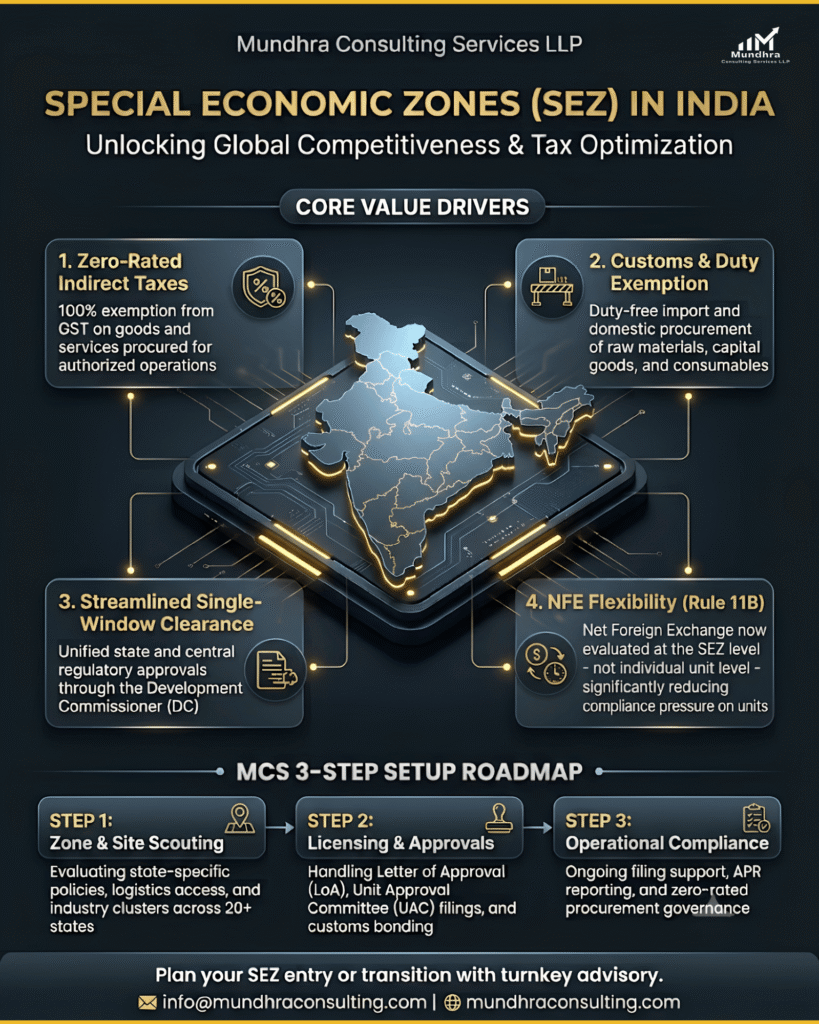
- Duty-Free Imports: SEZ units can import capital goods, raw materials, and consumables without paying Basic Customs Duty (BCD) or Integrated GST (IGST).
- Zero-Rated Domestic Procurement: Goods and services procured from the Domestic Tariff Area (DTA) into the SEZ are treated as zero-rated supplies under GST.
- Single Window Clearance: Routine customs examinations are minimized, and approvals for setup, operations, and export are streamlined through a centralized Development Commissioner.
The 7 Core Central Government SEZs
Prior to the widespread privatization and state-level expansion of SEZs under the 2005 Act, the Central Government established 7 primary zones. These foundational hubs remain some of the largest, most strategically located, and heavily utilized export centers in the country:
- Kandla SEZ (KASEZ) – Gujarat: India’s first EPZ, evolving into a massive multi-product hub with excellent connectivity to the Kandla Port.
- SEEPZ SEZ – Mumbai, Maharashtra: A highly specialized and lucrative zone primarily dominating the export of Electronics, Gems, and Fine Jewellery.
- Noida SEZ (NSEZ) – Uttar Pradesh: A crucial multi-product zone serving the vast manufacturing and IT demands of the Delhi-NCR region.
- Madras SEZ (MEPZ) – Chennai, Tamil Nadu: Located in India’s manufacturing and auto-ancillary heartland, this multi-product zone drives heavy southern exports.
- Cochin SEZ (CSEZ) – Kochi, Kerala: Strategically positioned near the Cochin port, handling a diverse multi-product export portfolio including IT and electronics.
- Falta SEZ (FSEZ) – West Bengal: The primary multi-product gateway for eastern India’s export operations.
- Visakhapatnam SEZ (VSEZ) – Andhra Pradesh: A major multi-product zone capitalizing on the robust eastern coastline and deep-water port infrastructure.
Critical SEZ Compliance: The Complexity of DTA Sales
While the export benefits are immense, the most significant compliance risk for an SEZ unit occurs when it sells its finished goods back into the standard Indian market – known as the Domestic Tariff Area (DTA).
Because an SEZ is legally a “foreign territory,” selling goods into the DTA is classified as an import into India.
- The SEZ unit (or the DTA buyer) must file a formal Bill of Entry.
- Full Basic Customs Duty (BCD), Social Welfare Surcharge (SWS), and IGST must be paid on the transaction, just as if the goods arrived from a foreign country.
- Strict adherence to Net Foreign Exchange (NFE) earning calculations must be maintained. If DTA sales exceed permissible limits or NFE turns negative, the unit faces severe show-cause notices and the clawback of tax exemptions.
Optimize Your SEZ Setup & Compliance with MCS
A single misstep in HSN classification during a DTA sale or failing to accurately file your Annual Performance Reports (APR) can lead to crippling departmental penalties and the suspension of your SEZ operational license.
Mundhra Consulting Services (MCS) provides top-tier, PAN India indirect tax and customs advisory. From guiding foreign investors through initial SEZ unit approvals to managing complex customs litigation and duty optimization for DTA sales, our expert counsels protect your capital and ensure frictionless regulatory compliance.

Planning A New SEZ Unit Setup or Need An Audit Of Your Current DTA Sales Compliance?
Also Read: New GST Rate List 2026: GST Slabs and Items Rate (Updated)
Complete State-Wise Directory of Special Economic Zones in India
The following is an exhaustive breakdown of states and union territories hosting operational Special Economic Zones (SEZs) in India, including key city hubs and their primary industrial focus:
1. Andhra Pradesh
- Key Hubs: Visakhapatnam, Nellore, Kakinada, Chittoor, Srikakulam.
- Primary Industries: Pharmaceuticals, IT/ITES, Textiles and Apparel, Multi-Product, Leather, Food Processing, Building Products.
2. Chandigarh (Union Territory)
- Key Hubs: Chandigarh.
- Primary Industries: IT/ITES, Electronics Hardware.
3. Chhattisgarh
- Key Hubs: Rajnandgaon, Naya Raipur.
- Primary Industries: Solar, IT/ITES.
4. Goa
- Primary Industries: IT/ITES.
5. Gujarat
- Key Hubs: Kandla, Surat, Mundra, Vadodara, Bharuch, Ahmedabad, Gandhinagar, Dahej.
- Primary Industries: Multi-Product, Apparel, Hi-Tech Engineering, Chemicals, Non-conventional Energy/Solar, IT/ITES, Multi-Services.
6. Haryana
- Key Hubs: Gurugram (Gurgaon), Sonepat.
- Primary Industries: IT/ITES, Electronic Hardware, Agro and Food Processing.
7. Jharkhand
- Key Hubs: Godda, Adityapur.
- Primary Industries: Power.
8. Karnataka
- Key Hubs: Bangalore (Bengaluru), Mysore, Mangalore, Hassan, Belgaum, Shimoga, Dharwad.
- Primary Industries: IT/ITES, Bio-technology, Aerospace, Precision Engineering, Pharmaceuticals, Electronics Hardware.
9. Kerala
- Key Hubs: Cochin (Kochi), Thiruvananthapuram, Malappuram, Ernakulam, Kozhikode, Thrissur.
- Primary Industries: Multi-product, IT/ITES, Port-Based, Animation & Gaming, Agro Based Food Processing, Electronics.
10. Madhya Pradesh
- Key Hubs: Indore.
- Primary Industries: IT/ITES, Multi-product.
11. Maharashtra
- Key Hubs: Mumbai, Pune, Nagpur, Aurangabad.
- Primary Industries: Electronics, Gems & Jewellery, IT/ITES, Pharmaceuticals.
12. Nagaland
- Key Hubs: Dimapur.
- Primary Industries: Agro and Food Processing.
13. Odisha
- Key Hubs: Bhubaneswar, Khurda.
- Primary Industries: IT/ITES, Metallurgy, Aluminium.
14. Punjab
- Key Hubs: Mohali.
- Primary Industries: IT/ITES.
15. Rajasthan
- Key Hubs: Jaipur, Jodhpur.
- Primary Industries: Handicrafts, IT/ITES, Gems & Jewellery.
16. Tamil Nadu
- Key Hubs: Chennai, Coimbatore, Tuticorin.
- Primary Industries: Textiles, IT/ITES, Automobiles, Engineering, Footwear, Food Processing.
17. Telangana
- Key Hubs: Hyderabad.
- Primary Industries: IT/ITES, Aviation, Pharmaceuticals.
18. Tripura
- Key Hubs: South Tripura District.
- Primary Industries: Rubber, Agro Based Food Processing.
19. Uttar Pradesh
- Key Hubs: Noida, Greater Noida.
- Primary Industries: IT/ITES, Handicrafts, Electronics.
20. West Bengal
- Key Hubs: Kolkata.
- Primary Industries: IT/ITES, Leather, Gems & Jewellery.
Also Read: Custom Import Duty Calculator India
