
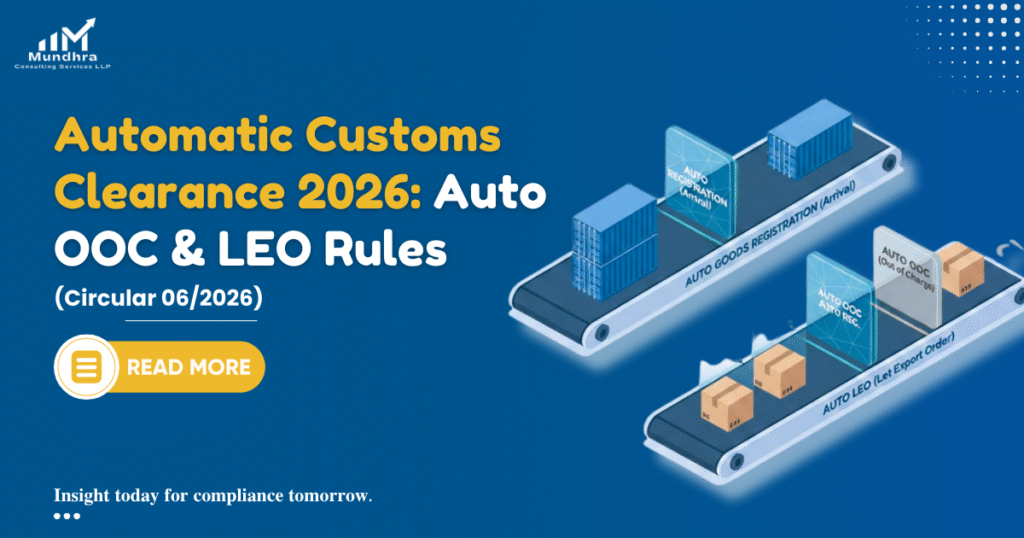
In a major push towards a fully Faceless, Contactless, and Paperless Customs environment, the Central Board of Indirect Taxes and Customs (CBIC) has introduced groundbreaking measures to automate the clearance process.
Vide Circular No. 06/2026-Customs, dated February 1, 2026, the Board has enabled Automatic Goods Registration and expanded the scope of Auto Out of Charge (OOC) and Auto Let Export Order (LEO).
Here is a detailed breakdown of what has changed for Importers and Exporters.
1. Auto Registration & Universal Auto OOC
The new measures aim to minimize physical interface and reduce dwell time upon the arrival of goods.
A. Auto Goods Registration (On Arrival)
Instead of the existing web-based registration which required manual initiation, the Customs System will now automatically register goods on arrival for specific categories of importers.
Who is Eligible?
- AEO T2 & T3 Entities: Automatic registration replaces the web-based process.
- Eligible Manufacturer Importers: A new class of importers notified under Notification No. 12/2026-Customs (N.T.).
- Longstanding Supply Chains: Importers with a proven, consistent track record.
- DPD Importers: Entities availing Direct Port Delivery facilities.
B. Auto Out of Charge (OOC) for ALL
This is the most significant change. Previously limited to AEO T2/T3 entities, the facility of Auto Out of Charge (OOC) is now extended to ALL Importers.
Conditions for Auto OOC:
- Duty must be paid (if applicable).
- No pending compliance requirements.
2. Export Updates: Contactless Registration & Auto LEO
For exporters, the focus is on eliminating the need to physically visit Customs officers for goods registration.
A. Auto Goods Registration (Sealed Cargo)
- Universal Access: An online goods registration facility is being enabled for all exporters, removing the need for physical interaction.
- Nhava Sheva Pilot: A specific pilot project for e-seal based auto goods registration is launching at Nhava Sheva (INNSA1). This will be expanded to other ports as e-seal scanners are installed.
B. Auto Let Export Order (LEO)
Once goods are registered, the System will grant Auto LEO to all exporters based on risk evaluation.
Criteria for Auto LEO:
- Shipping Bill is not selected for examination or assessment.
- No NOC is required from any Partner Government Agency (PGA).
- Applicable Export Duty/Cess has been paid.
The “Risk” Safeguard
While the system defaults to “Automatic,” Customs retains control. Officers can invoke a “HOLD” in the Customs System to override Auto OOC or Auto LEO if there is specific intelligence or risk capability triggers.
Conclusion
These changes effectively remove the manual bottlenecks at the two most critical stages of trade: Registration (entry) and OOC/LEO (exit). Businesses should ensure their duty payments and PGA compliances are spotless to take full advantage of this “Green Channel” speed.
Official Notification
Want to read the official text? You can view the full Circular No. 06/2026-Customs issued by the CBIC below.
