
Source: DGFT Public Notice No. 42/2025-26
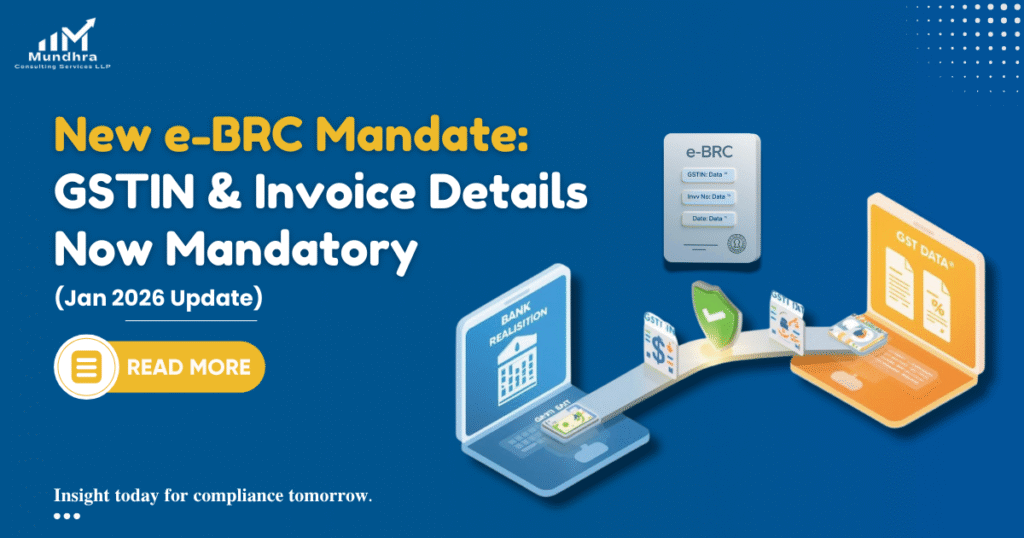
e-BRC GSTIN Mandatory 2026
The Directorate General of Foreign Trade (DGFT) has issued a significant update that fundamentally changes how Electronic Bank Realisation Certificates (e-BRC) are generated. In a move to tighten the loop between banking data and tax data, the government has amended Appendix 2U of the Handbook of Procedures, 2023.
Effective from January 13, 2026, the “Shipping Bill” is no longer the sole anchor for export realization. The new system explicitly links export proceeds to your GST Invoices.
Here is everything exporters and finance teams need to know to ensure compliance and avoid disbursement delays.
What Has Changed? (The “Tripwire” Update)
Previously, e-BRC generation primarily focused on linking the foreign remittance to the Shipping Bill. While GST data was relevant, it wasn’t strictly enforced at the data-field level in the certificate itself.
With Public Notice No. 42/2025-26, issued on January 9, 2026, the DGFT has revamped the e-BRC format to include three new mandatory fields:
- GSTIN (GST Identification Number of the Exporter)
- GST Invoice Number
- GST Invoice Date
Additionally, the field previously labeled “Address/GSTIN” has been simplified to just “Address” to ensure cleaner data segregation.
Why This Matters: The “Linkage” Logic
The government’s objective is clear: Zero Discrepancy.
By mandating these fields, the DGFT is creating a direct digital link between your Foreign Exchange Realisation (Bank) and your Domestic Tax Filing (GST).
- Before: Verification relied heavily on matching Shipping Bills. Mismatches between the value declared in GST returns and the value realized in the bank were hard to track in real-time.
- Now: The system effectively matches the money received directly to the specific tax invoice generated. This ensures that the export turnover claimed in GST refunds matches the actual foreign currency realized.
The Impact: If your GST Invoice details in the e-BRC do not match your GSTR-1 filings, it could trigger immediate red flags for both DGFT and GST authorities.
Key Takeaways for Exporters
If you are an exporter, this change is already effective (as of Jan 13, 2026). Here is your immediate action plan:
1. Update Your Banking Instructions
Ensure that when you submit documents to your bank (Authorized Dealer) for realization, you explicitly provide the GST Invoice Number and Date corresponding to each shipment. Banks cannot generate the compliant e-BRC without this data.
2. Reconcile Invoices vs. Shipping Bills
In many cases, one Shipping Bill covers multiple invoices, or one invoice covers multiple Shipping Bills.
- Action: Ensure your internal ERP or accounting software allows for this level of granularity. You must be able to map every dollar received back to a specific GST Invoice.
3. Check for Mismatches
Any discrepancy between the Invoice Number filed in your GSTR-1 and the Invoice Number reported for e-BRC could lead to:
- Rejection of the e-BRC generation.
- Stoppage of export incentives/disbursements.
- Notices regarding “Unrealized Export Proceeds” under FEMA.
Conclusion
This amendment is not just a formatting change; it is a structural shift towards automated compliance. The government is removing the manual gap between “Customs Data” and “Tax Data.”
Exporters should treat January 13, 2026, as the cut-off date. All realizations processed from this date onwards must strictly adhere to the new format to ensure seamless business operations.
Official Notification
Want to read the official text? You can view the full Public Notice No. 42/2025-26 issued by the DGFT below.
